The One-Way Street Myth of Cultural Exchange
Cultural exchange is not a one-way street: trace how borrowed forms are adapted, answered and returned, and see influence as a changing relationship.
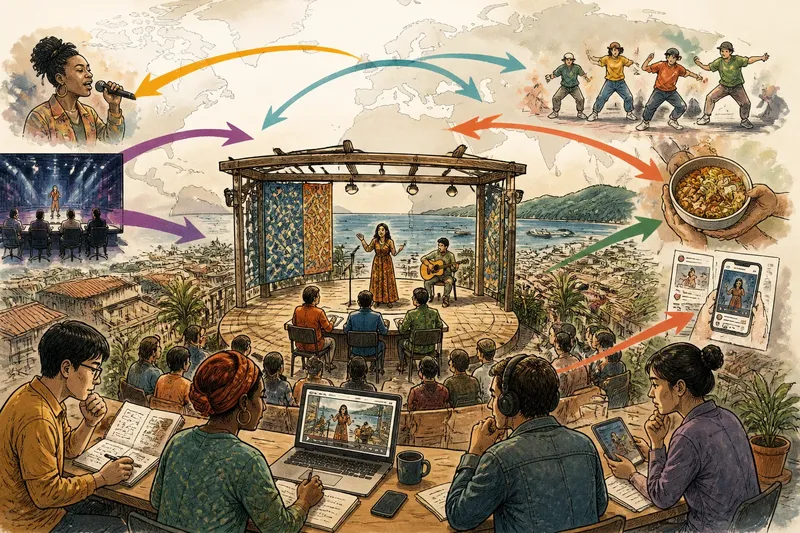
The common mistake is to treat cultural exchange as a delivery: a powerful centre exports a style, and everyone else receives it. That account misses the local decisions that alter the style, the replies that travel back, and the new forms created along the way. Cultural exchange is better understood as a relationship with several turns, not a parcel with one sender.
Influence is not delivery
When a song, garment, recipe, phrase or screen format crosses a border, it does not arrive untouched. People encounter it through their own languages, habits, institutions and tastes. They may copy one feature, reject another, or combine it with something already familiar. The result can still carry traces of its source, but it is no longer simply the source carried elsewhere.
This distinction matters because visibility and influence are not the same thing. A wealthy country’s films may be easy to distribute internationally, while the preferences of audiences elsewhere shape which stories distributors buy, which actors become familiar and which conventions are revised. The first movement may be outward; the next is often a response that changes what gets made.
Think of a borrowed tune as a recipe copied onto a kitchen card. The card can travel unchanged, but the cook chooses what to keep, what to substitute and what to serve alongside it. Culture is less obedient than a card: people can argue over the recipe, alter its meaning and send the revised version elsewhere.
Adaptation makes meaning
Adaptation is not a minor local decoration added after the important creative work is done. It is one of the ways meaning is made. A borrowed form can be used to express a local concern, address a different audience or fit a setting that its original makers did not anticipate.
Consider a hypothetical case: a small theatre group in a coastal town encounters a popular television talent format. The group keeps the familiar audition and judging structure, but invites performers to use songs in several local languages and lets audience members discuss what each song means to the town. Viewers may recognise the format, yet the programme now reflects local relationships and priorities. If clips circulate elsewhere, audiences outside the town meet a version shaped by those choices.
That does not mean the adaptation is automatically fair or free of tension. The original owners may control licences or distribution, while local performers contribute ideas without gaining comparable credit or access. Cultural exchange can be creative and unequal at once. Naming the adaptation helps describe what people made; examining ownership shows who can profit from it.
Audience response travels
Audiences do more than receive cultural products. They select, interpret, discuss and sometimes refuse them. Their reactions can travel through ticket sales, fan communities, reviews, translation requests, social media and conversations among distributors. Those signals may influence later creative decisions, though no single audience response dictates what happens next.
The route is rarely tidy. A production may be altered for one market, criticised in another and embraced by a diaspora community in a third. A translation can make a joke legible while removing a reference that mattered to its original audience. People who move between places may carry interpretations with them, connecting communities that a simple map of export and import would leave apart.
It is useful to distinguish reception from endorsement. A community can watch a foreign series and make it part of local conversation without adopting every value it depicts. Likewise, a locally made version may borrow a format while using it to challenge the assumptions attached to the original. Attention is evidence of contact, not proof that audiences have become alike.
Return is not reversal
When an adapted form travels back towards the place associated with its source, the movement is sometimes called return influence. The phrase can make the process sound like a completed circle: an idea leaves, changes abroad, then comes home. In practice, there may be many routes, and no single point at which the idea becomes original again.
Imagine a hypothetical dance style that begins in a neighbourhood, spreads through migration and online video, and is reshaped by performers in several cities. A production company later promotes one of those versions in the neighbourhood where the style first gained local meaning. Residents may welcome its new gestures, argue over who is credited, or recognise elements that have since changed at home. The returning version does not restore an earlier form; it adds another interpretation to an ongoing exchange.
Return can also reveal how a place is viewed from outside. An adapted image may be marketed back to its place of origin as an exotic discovery, even though local people recognise it as familiar or incomplete. That gap is not just a misunderstanding. It can reflect who has the power to name a trend, package it and make money from its circulation.
Who controls the route?
To understand an exchange, follow more than the cultural object. Ask who makes it, who changes it, who translates it, who distributes it and who is credited. A popular food, musical style or performance format may involve cooks, musicians, translators, organisers, platform companies and audiences. The most visible name is not necessarily the only source of creative labour.
Control over circulation can shape what counts as influence. A company with a large distribution network may make its version easier to encounter, while smaller makers struggle to reach the same audience. But reach alone does not explain the relationship. Local performers may change a form in ways that later become commercially attractive elsewhere; community audiences may preserve a practice that commercial channels overlook.
For a particular case, useful questions include:
- What form or practice crossed into a new setting?
- Which parts were kept, changed, or deliberately left out?
- Who had permission and resources to circulate the resulting version?
- Whose labour and contribution were named?
- Did the adapted form travel onward, and how did people respond to it?
These questions do not turn exchange into a simple balance sheet. They make visible the difference between contact, adaptation and control. A form can be widely copied while its makers remain uncredited; another can travel through personal ties without becoming commercially prominent.
What does exchange mean?
Is cultural exchange always equal?
No. People can influence one another while having very different access to money, distribution, legal protection and public recognition. Describing exchange as two-way should not erase those differences.
Does borrowing make a form less authentic?
Not by itself. Cultural forms are often sustained through change, and a borrowed element can acquire local meaning through use. Questions about permission, credit and benefit are separate from the claim that a culture must remain unchanged to be authentic.
Can audiences influence what creators make?
They can, through attention, criticism, requests, organised discussion and choices about what to support. Creators and distributors interpret those signals alongside budgets, rights and their own priorities, so audience response is influential without being a command.
How can I trace an exchange?
Follow one recognisable form across the people and places involved: note what changes, who explains those changes, and how the result circulates. Seek accounts from makers and audiences in more than one location rather than treating a distributor’s description as the whole story.
Follow the changes
The most useful account of cultural exchange does not ask only where an idea began. It asks what happened after people encountered it: what they adapted, what they answered, and which version travelled next. That approach can show both creative agency and uneven power without pretending they cancel each other out.
For the phrase cultural exchange, the practical test is simple: look for the changes between arrival and onward movement. If a description names only a powerful centre and its receivers, it has probably left out the people who interpreted the form and helped decide what it could become.