The Long Route Inside a Cotton Shirt
Trace the cotton shirt supply chain from farm to shop, separating confirmed origins from unknowns to see how trade connects workers and places.
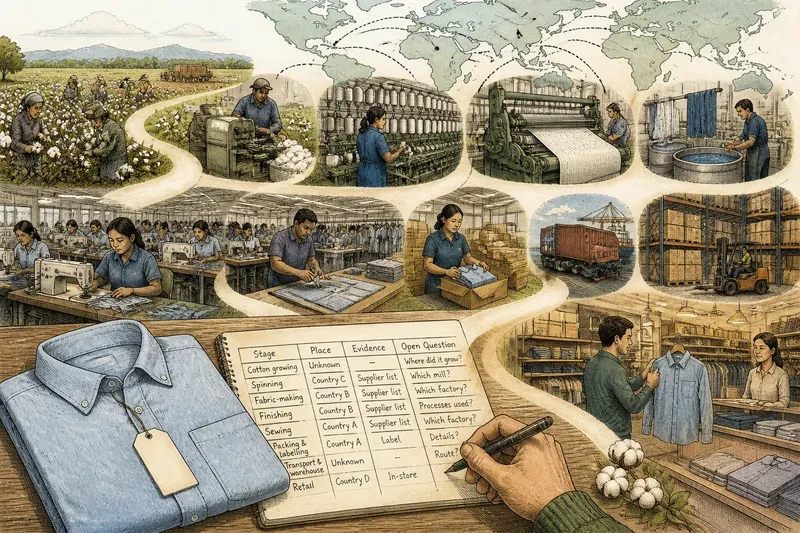
The most common mistake in tracing a cotton shirt is treating its label as its whole biography. That leaves the cotton shirt supply chain—and the workers, trade and resource decisions within it—out of view. A label may name where the garment was made, while cotton growing, spinning and fabric-making happened elsewhere.
Take one ordinary cotton shirt and follow the material through each hand-off: farm, mill, sewing room, warehouse and shop. The aim is not to infer a secret factory from a care tag. It is to see how work and materials connect places, and to keep the unreported stages distinct from the known ones.
Read the label
Check the fibre label, care instructions and country-of-origin statement, if present. Record their exact wording. “Cotton” identifies a fibre, not a farm; the country-of-origin statement refers to a legally relevant place of manufacture under applicable rules, not necessarily every stage in the supply chain.
Construction offers clues about the work involved, but not its location. A woven button-up shirt has a collar, cuffs, placket and seams assembled from cut fabric. A knitted T-shirt uses a different fabric structure and often a simpler arrangement of pieces. Neither design identifies the workers or factories.
Make a route table in a notebook or spreadsheet with columns for stage, place, evidence and open question. Enter “unknown” when the label is silent. It is a more useful entry than a guess, even if it is less satisfying to look at.
Trace cotton trade
Cotton starts as a crop. Growing and harvesting it involves farm labour and decisions about seed, land, water and pest management. After harvest, the cotton is cleaned to remove seeds and other plant material, then prepared for spinning.
The route can cross borders or pass between businesses within one country. Cotton may be sold through intermediaries, blended with fibre from different sources or stored before processing. A shirt label does not normally disclose these movements. If a brand publishes supplier information, check whether it names farms, cotton processors or only later-stage manufacturers: each describes a different reach into the chain.
Ask a specific question at each stage: what is reported about the cotton’s origin, and what remains unreported? A general statement about sourcing policy is not evidence about the particular shirt in your hands.
Follow fibre and fabric
At a spinning mill, prepared fibres are aligned and twisted into yarn. Workers and machinery turn loose cotton into a material suited to later processes. Yarn may come from a single fibre source or a blend, and it may be sold to another business, sent to a weaving or knitting mill, or processed within a larger manufacturing group.
Keep spinning distinct from fabric-making. A supplier list might name sewing factories while saying little about the businesses that made the yarn. That gap does not establish misconduct; it marks a limit on what the available information can support.
Yarn becomes cloth through weaving or knitting. In woven fabric, yarns cross; in knitted fabric, loops form a flexible surface. A crisp cotton shirt commonly uses woven cloth, while many casual T-shirts use knitted jersey. Fabric may then be dyed, printed or finished at the same mill or a separate facility. These processes add workers, materials and decisions about colour, texture and use.
Think of each supplier hand-off as a note passed between desks: a record can clarify what happened, while a missing note cannot tell you what happened at the previous desk. Keep yarn, fabric-making and finishing as separate entries rather than compressing them into “made somewhere”.
Cut and sew
At a garment factory, fabric is laid out, cut into pattern pieces and assembled. Workers may specialise in joining sleeves, attaching collars, sewing buttonholes or checking seams. The pattern and construction determine the operations required, while cutting plans affect cloth use.
The sewing factory may be in a different country from the spinning or fabric mill. After assembly, a shirt can be inspected, pressed, packed and labelled before shipment. The country-of-origin statement can identify a significant manufacturing location, but it does not map every earlier input.
Say you have a shirt whose label names Country A, a maker’s supplier list naming a sewing factory in Country A, and a fabric supplier listed in Country B. Enter those two places beside sewing and fabric-making, cite the label and supplier list as evidence, and leave cotton origin unknown. The resulting map shows a reported cross-border link without pretending to know where the crop grew.
Move from factory to shop
After sewing, shirts pass through packing, transport, warehousing and retail. The route may include a freight forwarder, port, distribution centre and shop, though the actual path varies. Retailers decide which designs to order and when to sell them; those commercial choices link production with the people who buy and wear the garment.
Work here is not limited to factory floors. Warehouse staff receive and sort cartons, transport workers move goods, and shop staff handle stock and customer questions. These jobs belong on a map of the shirt’s route even though they do not change the cotton or stitching.
Record physical movement separately from commercial ownership. A shirt can change hands between businesses without moving, or travel while remaining owned by one business. Public information may describe manufacturing sites more clearly than these intermediate arrangements, so mark what is known rather than supplying a tidy story.
What do labels reveal?
Does the label show where the cotton grew?
Usually, a fibre label identifies material rather than farm origin. A separate sourcing statement or supplier record may give more detail, but check which stage it covers.
Where was the shirt made?
The country-of-origin statement identifies a legally relevant place of manufacture under the rules that apply. It does not necessarily name where cotton was grown, yarn spun or fabric finished.
Can a brand trace every stage?
Some brands publish supplier information covering several production stages; others disclose only part of the chain. Read each claim for its named stage and scope instead of treating “traceable” as a complete map.
What should I do with missing information?
Mark the stage unknown, then look for a specific supplier list or sourcing statement if you want to investigate further. Do not infer origins from a brand’s headquarters or the garment’s final country of manufacture.
Build a reliable map
Review the route from crop to shop. For each stage, record the place only when evidence supports it, and note whether the source is the garment label, a brand page or supplier disclosure. Use these checks to decide what the map can reasonably say:
- Check whether the fibre label names a material only; if it does, record the fibre and leave farm origin unknown, but seek a sourcing record if origin matters to your map.
- Check whether the origin statement names a country; if it does, enter it beside garment manufacture, but do not apply it to cotton growing or yarn production.
- Check whether a supplier list names a spinning mill; if it does, record spinning separately, but leave the stage unknown if the list identifies only sewing factories.
- Check whether fabric-making and finishing are both identified; if they are, enter each reported place, but keep the unreported process marked unknown rather than merging the stages.
- Check whether the evidence names the sewing factory; if it does, record that site as reported assembly, but do not assume it made the fabric as well.
- Check whether transport records identify a route; if they do, note the reported hand-offs, but leave the path open if only the destination or retailer is known.
A finished map might show cotton growing, cleaning, spinning, weaving or knitting, finishing, cutting, sewing, packing, transport and sale, with evidence beside each confirmed detail. It makes visible how farm labour produces fibre, mill workers prepare yarn and cloth, garment workers assemble the shirt, and logistics and retail workers carry it onwards. Each task depends on decisions made elsewhere, including orders, specifications and delivery schedules.
The cotton shirt supply chain is rarely printed in full on the garment, and careful reading cannot recover private records that have not been shared. A more useful account follows the connections that evidence supports, leaves the gaps visible and treats unknowns as part of the route—not as a reason to stop following it.