Before the Container, Freight Travelled in Pieces
Before container shipping, loose cargo passed through many hands. See why handling caused delays and damage, and how standard containers changed the work.
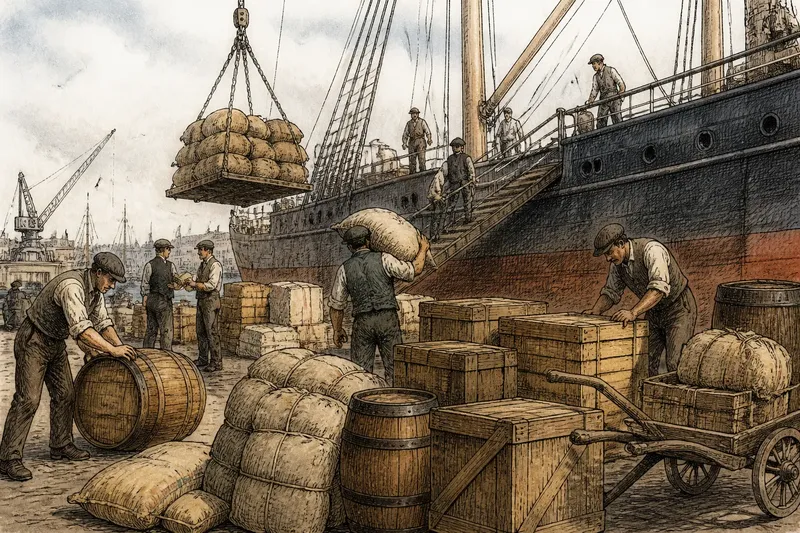
The common mistake is to imagine an old cargo ship as a container vessel with its boxes removed. Before container shipping, freight arrived in sacks, barrels, crates, bales and bundles, each needing its own handling. That extra work cost time, demanded skilled dock labour and left goods exposed to damage and confusion between ship, quay and warehouse.
The change was not simply from small loads to large ones. It was from cargo that had to be managed piece by piece to cargo that could travel in a standard unit. If you are trying to understand why containerisation altered trade routes, start with the work that loose freight required—and the problems that work created.
Loose freight bottlenecks
Break-bulk cargo, the usual term for goods stowed separately rather than in a single container, could be anything from timber to machinery. Ships carried a mix of packages, and each had to be counted, moved and placed with its shape, weight and destination in mind. A crane might lift a pallet or sling of sacks, but much of the work still relied on dockers carrying, rolling, stacking or guiding individual pieces.
The first problem was the number of handovers. A consignment might pass from a lorry to a quay, from the quay into a ship’s hold, then out again at another port and into a warehouse or another vehicle. Each transfer involved people, records and opportunities for cargo to be misplaced or damaged. A loose parcel could not simply be identified by the ship that carried it; it needed to be matched to papers, markings and a place in the load.
Imagine a merchant sending a mixed consignment of tea chests and metal fittings from a port warehouse to a ship. If the fittings are marked for a different consignee but stacked beside the tea, the loading tally and the stowage plan must keep their destinations distinct. The expected result of careful sorting is that both lots can be found and discharged correctly; if marks are obscured or records disagree, workers have to stop and resolve the mismatch.
Damage and delay
Separate handling made cargo vulnerable in ordinary, unglamorous ways. A sack could split against a rough edge, a barrel could shift, and a crate could be crushed beneath a heavier item. Goods also faced weather while waiting on the quay, and salt air or damp could be unwelcome company for cargo that was not properly protected.
When a shipment arrived late or incomplete, the cause was not always a slow ship. Loading and unloading could take substantial labour, especially where a vessel carried many kinds of goods with different handling needs. A delay in one part of the cargo could hold up the next operation, while an unclear tally could prompt a search through a warehouse or hold. The ship was only one link in a chain that moved at the pace of its most awkward transfer.
For a reader examining an old freight account, distinguish sailing time from port time. Port records, bills of lading and cargo manifests describe different parts of the process: the manifest lists cargo aboard, while a bill of lading records a carrier’s receipt and the terms of carriage. Neither document alone tells the whole story of how long each package waited or who physically moved it.
What caused the trouble
Three recurring causes explain much of the friction:
- Mixed cargo: packages with different sizes, weights and destinations needed sorting before they could be stowed efficiently.
- Repeated transfers: every move between ship, quay, warehouse and inland transport added handling and another chance for error.
- Incompatible records: marks, tallies and shipping papers had to agree, even when cargo was split, combined or moved between carriers.
These were connected problems, not separate annoyances. A shipment sorted poorly at the warehouse could be awkward to stow; awkward stowage could make discharge slower; and a rushed discharge could make a tally harder to reconcile. The arrangement resembled moving house with loose objects rather than boxes: the furniture may travel, but everyone spends time asking where the smaller things went.
Container shipping changes
A standard container changed the unit of handling. Instead of lifting each package separately at every transfer, workers could move a loaded container as one unit between suitable ships, lorries and rail wagons. The goods inside still needed packing and records, but the cargo no longer had to be individually handled whenever the transport mode changed.
That shift depended on standard dimensions and compatible equipment. Ports needed cranes, storage areas and vehicles designed to handle the same units; shipping lines and trading partners needed shared procedures. Where those systems were in place, cargo could move through a more continuous chain. Where they were not, the container might still have to be unloaded or transferred in a less direct way.
Containerisation also changed the kind of work involved. It reduced some repetitive handling of individual packages while increasing the importance of operating cranes, planning yard movements, securing loads and tracking units across transport links. It did not make labour disappear; it changed where expertise was needed and how much cargo a port could organise as a single flow.
Reading old cargo records
If an old shipping document seems to describe a jumble, look for the practical clues rather than expecting a modern freight code. Package type, marks, consignee, port of discharge and any stated handling needs can help explain why two items travelled together—or why they did not. A cargo description such as “bales” or “cases” tells you about the form in which goods were handled, not necessarily what was inside each package.
When records disagree, avoid assuming that one was carelessly written. A manifest, warehouse tally and bill of lading could be prepared for different purposes and at different points in the journey. The useful question is what each record was meant to track: the goods loaded, the goods received, or the carrier’s responsibility for them.
Questions about freight?
What was break-bulk cargo?
Break-bulk was cargo shipped as separate packages rather than inside a standard container. Sacks, barrels, crates and bundles were common forms, each requiring its own handling and often its own place in the ship’s stowage.
Why did loading take so long?
Workers had to sort and move many packages, stow them so they would not shift or crush one another, and keep destinations and tallies straight. The mix of goods mattered as much as the ship’s capacity.
Did containers end dock work?
No. They changed the work from repeated handling of loose packages towards moving, securing and tracking larger units. Ports also needed equipment and transport links built to handle those units.
Could every good travel in a container?
No. Goods that were unusually large, awkward, or suited to other forms of carriage could require different arrangements. The container was a powerful standard, not a universal answer to every cargo problem.
What to try first
When comparing a loose-cargo route with a container route, trace the transfer points in order rather than focusing only on the ship. Check what was packed, how it was moved at each port, which records followed it and where compatible handling equipment was available. That sequence shows why the container mattered: it made the cargo unit itself travel more consistently, while leaving the work of trade—and its need for accurate records—very much in place.